The Twelve Codes: 12 Quietly Disruptive® Principles for Building Your Corner of the World
There’s a type of entrepreneur who doesn’t fit the narrative we’re sold.
They’re not the ones shouting about their revenue on LinkedIn, or posting hustle-at-4am content, or building empires they’ll burn out inside of by forty. They’re the ones who’ve been quietly reshaping their industries, their communities, their corners of the world, without a microphone, without a spotlight, and often without anyone noticing at all.
They’re quietly disruptive. And until now, they haven’t had language for it.
The Twelve Codes are that language. Not a set of rules, not a programme to follow or a framework to master, but a way of operating, twelve principles that describe how a certain kind of founder already moves through the world, even if they’ve never been able to articulate it. And for those who’ve lost that instinct, buried under years of people-pleasing, conforming, and building businesses that look successful but feel completely wrong, the Codes are the path back.
This page exists because I believe that the most powerful disruption doesn’t come from the loudest voice in the room. It comes from the person who left the room, built something remarkable, and let the results speak.
If that’s you, or if it used to be, you’re in the right place.
What does Quietly Disruptive® actually mean?
Quietly Disruptive® is a philosophy of entrepreneurship built on a single conviction: that you can reshape your industry, your life, and your corner of the world without performing, without broadcasting, and without sacrificing who you actually are in the process.
It’s not passive. It’s not playing small. It’s not hiding. It’s the deliberate choice to lead with execution over announcement, substance over show, and quiet confidence over loud hustle, the understanding that doing the work and performing the work are two fundamentally different things, and choosing the first, every time.
The term was born from twenty-five years of building unconventional businesses, starting at sixteen when I was too naive to know I was supposed to be scared, and from watching the most talented founders I know operate the same way: in silence, with intention, letting their work make the noise.
Quietly Disruptive® is not a brand. It’s a belief system. The Twelve Codes below are how it works.
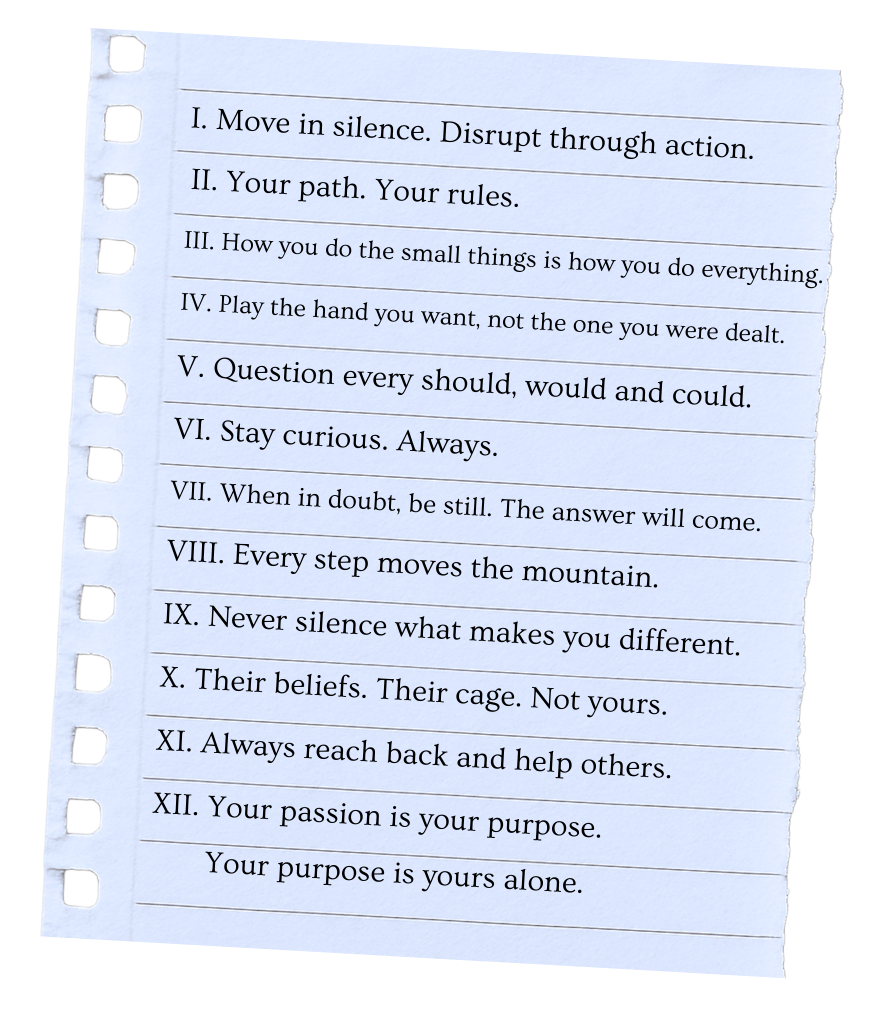
The Twelve Codes
These twelve principles aren’t aspirational. They’re observational. They describe how Quietly Disruptive founders already think, build, and move, and they serve as a compass for anyone finding their way back to that instinct after losing it.
I. Move in silence. Disrupt through action.
The world has confused visibility with value. We see founders spending more time documenting their journey than actually walking it, curating highlights, crafting narratives, performing progress. And somewhere along the way, the performance became the product.
Quietly disruptive founders don’t announce their next move. They make it. They don’t post about the pivot, they execute it, and people notice because the results are undeniable, not because the content strategy was clever.
This isn’t about secrecy. It’s about priorities. When you move in silence, your energy goes into the work, not the optics. And the work, done well, done consistently, done with intention, becomes its own announcement.
Reflection: When was the last time you did something meaningful in your business without telling anyone about it first?
II. Your path. Your rules.
There is an extraordinary amount of pressure in entrepreneurship to follow a template. Someone else’s morning routine. Someone else’s pricing model. Someone else’s growth strategy. And it’s seductive, because templates feel safe, if it worked for them, surely it’ll work for you.
Except it rarely does, because their path was built for their life, their values, their capacity, their ambition. Yours has to be built for yours. That means making decisions that look odd from the outside, like finishing work at 4pm every day, or turning down clients who’d double your revenue, or building slowly in a world that worships speed. It means trusting that the path you’re walking is valid even when no one else is on it.
Your rules aren’t limitations. They’re the architecture of a business that actually fits your life.
Reflection: Which ‘rule’ in your business did you inherit from someone else, and does it actually serve you?
III. How you do the small things is how you do everything.
This one isn’t about perfectionism, though it can look like it from the outside. It’s about integrity. The email you send when you’re tired. The invoice you follow up on. The conversation you have when no one’s watching. The quality of work you deliver when the client will probably never notice the difference.
Quietly Disruptive founders understand that excellence isn’t a switch you flip for important moments. It’s a frequency you operate on. And people feel it, even when they can’t name it. The client who stays for years, the referral that comes unprompted, the reputation that builds without a marketing budget, all of that comes from the way you handle the small, unglamorous, invisible stuff.
Not because you’re performing excellence. Because it’s just how you’re wired.
Reflection: What’s one small thing in your business you’ve been cutting corners on, and what would change if you didn’t?
IV. Play the hand you want, not the one you were dealt.
Most business advice starts with what you have: your skills, your experience, your existing client base, your current revenue. And there’s wisdom in that, you build from where you are. But quietly disruptive founders do something different. They build toward where they’re going.
That means making decisions today based on the business you’re creating, not the one you’re currently running. Pricing for the clients you want, not the ones you have. Saying no to work that doesn’t fit, even when the revenue would be welcome. Treating constraints, single parent, limited hours, unconventional background, not as handicaps but as design features of a business that works differently, and better.
You weren’t dealt a hand. You’re building one. And you get to choose which cards you play.
Reflection: If you designed your business from scratch today, no obligations, no guilt, what would you do differently?
V. Question every should, would, and could.
The word ‘should’ is the most dangerous word in a founder’s vocabulary. You should be on TikTok. You should scale. You should be grateful for the clients you have. You should work harder. You should be further along by now. Every ‘should’ is someone else’s expectation wearing a disguise, and most of us have internalised so many of them that we can’t tell the difference between what we actually want and what we think we’re supposed to want.
Quietly disruptive founders interrogate every assumption, not with rebellion (that’s just reacting), but with curiosity. Why am I doing this? Who said I had to? What happens if I don’t? The answers are often surprisingly freeing, because when you strip away the shoulds, what’s left is usually the thing you actually want to build.
Reflection: What are you doing in your business right now purely because you think you ‘should’?
VI. Stay curious. Always.
Certainty is comfortable but dangerous. The moment you stop asking questions, about your market, your methods, your assumptions, yourself, is the moment your thinking stops moving. Curiosity is what keeps a business alive, not in the Instagram-inspirational sense of ‘stay hungry,’ but in the genuinely practical sense of remaining open to what you don’t know yet.
The best founders I’ve worked with aren’t the ones with the most answers. They’re the ones who ask the best questions. They treat not-knowing as data, not failure. They follow tangents because tangents are often where the real insight lives. They stay curious about their own patterns, asking questions like: why do I keep saying yes to this kind of work? why does this particular thing drain me?, because self-curiosity is the engine of change.
Reflection: What question have you been avoiding asking yourself about your business?
VII. When in doubt, be still. The answer will come.
We live in a culture that equates speed with competence. If you’re not moving fast, you’re falling behind. If you’re not deciding quickly, you’re indecisive. If you’re not shipping constantly, you’re stalling.
Quietly Disruptive founders know that stillness is a strategy, not a symptom. When you don’t know what to do next, the worst thing you can do is panic into action, take on a client you don’t want, launch a product you’re not ready for, pivot because everyone else seems to be pivoting. The best thing you can do is stop. Wait. Let the clarity come to you instead of chasing it.
This isn’t passive. It’s disciplined. It takes more courage to sit in the uncertainty than to fill it with noise. And the answers that come from stillness are almost always better than the ones that come from panic.
Reflection: When was the last time you made a business decision from stillness rather than urgency?
VIII. Every step moves the mountain.
Change doesn’t happen in dramatic breakthroughs, even if that’s what the success stories on LinkedIn would have you believe. It happens in the accumulation of small, consistent, often invisible steps. The LinkedIn message you sent on a Tuesday that led to a conversation that led to your best client. The boundary you held once that changed how everyone interacted with you from that point forward. The blog post no one seemed to read that someone quoted back to you six months later.
You will rarely feel the mountain move. But every step counts. Every piece of work you put into the world, every conversation you have, every boundary you hold, it’s all compounding, even when you can’t see it. Especially when you can’t see it.
The founders who build the thing they actually want aren’t the ones who made one bold leap. They’re the ones who kept walking.
Reflection: What’s one small step you could take this week that your future self would thank you for?
IX. Never silence what makes you different.
This is perhaps the hardest code to live by, because everything in professional culture teaches us to smooth our edges. Be palatable. Be relatable. Don’t be ‘too much.’ Don’t be ‘too different.’ Fit in enough to be taken seriously, then maybe, once you’ve earned enough credibility, you can show who you actually are.
The problem is, by the time you’ve earned that permission, you’ve often forgotten what you were trying to show. You’ve spent so long conforming that the thing that made you different in the first place has gone quiet. Your voice. Your perspective. Your way of doing things. The very thing that would have been your greatest asset became the thing you buried.
Quietly disruptive founders don’t silence what makes them different. They build around it, not loudly, this isn’t about being provocative for the sake of it, but refusing to edit themselves into someone more comfortable for other people to deal with.
Reflection: What part of yourself or your approach have you been downplaying to make others more comfortable?
X. Their beliefs. Their cage, not yours.
Other people’s opinions about what’s possible, what’s professional, what’s realistic, those are theirs, built from their experiences and their limitations. The colleague who says you can’t charge that much. The family member who thinks you should get a ‘proper job.’ The industry voice insisting you need to be on every platform, attend every event, grow at a certain pace.
Their beliefs aren’t wrong, necessarily. They’re just theirs. Built from their context, their capacity, their fears. And you don’t have to live inside them.
This code isn’t about dismissing other people (that’s arrogance, not disruption). It’s about recognising that someone else’s ceiling doesn’t have to be your ceiling. Their idea of what a successful business looks like doesn’t have to become your blueprint. You can hear their perspective, consider it, and then choose your own path anyway.
Reflection: Whose voice is loudest in your head when you’re making business decisions, and is it actually yours?
XI. Always reach back and help others.
Quietly Disruptive founders don’t build in isolation. They build with a hand extended behind them.
This isn’t about performative mentorship or building a following. It’s about remembering what it felt like to be stuck, scared, unsure, and choosing to be the person you needed when you were there. Sharing what you know without gatekeeping. Answering the message from someone who’s three years behind you. Being honest about what it actually took, not just what looked good.
Because disruption that only serves you isn’t disruption. It’s just ambition. The real work is building something that opens doors for other people too, quietly, without needing credit, because that’s simply how you operate.
Reflection: Who could you help right now with something you’ve already learned the hard way?
XII. Your passion is your purpose. Your purpose is yours alone.
There’s an industry built on telling you that you need to ‘find your purpose,’ as if it’s hiding somewhere you haven’t looked yet, waiting to be discovered in a workshop or a journal prompt or a weekend retreat. But the truth is simpler than that, and also harder: your passion is your purpose. The thing you’d do even if no one was watching. The work that doesn’t feel like work. The conversation you never get tired of having.
And your purpose is yours alone. Not your partner’s. Not your industry’s. Not the version of purpose someone else decided was more ‘impactful’ or more ‘scalable’ or more worthy of your time. Yours. The one that makes sense to you, even if it doesn’t make sense to anyone else.
This is the final code because it’s the one that holds all the others together. When you build from your actual passion, not from obligation or expectation or what the market says you should want, everything else follows. The boundaries become natural. The silence becomes powerful. The disruption becomes inevitable.
Reflection: If you stripped away every external expectation, what would you actually want to spend your days doing?
How to use the Twelve Codes
This isn’t a checklist. You don’t score yourself against it, and you don’t fail if you’re not living all twelve principles perfectly (no one is, including me).
Think of it as a lens. When you’re stuck on a decision, read through the codes and notice which one lands. When something in your business feels off, ask yourself which principle you’ve been ignoring. When you’re not sure whether to say yes or no, let the Twelve Codes be the filter.
Some founders pin one code to their desk for a month and let it inform everything. Others read the full list every quarter as a reset. There’s no right way to use it, which is, of course, entirely the point.
Where the Twelve Codes come from
I started my first business at sixteen during my maths GCSE. By twenty, I’d built it into the largest model horse stockist in Europe, with 50,000 customers worldwide and a six-figure turnover. I was Quietly Disruptive before I had language for it, building unconventional things without asking permission, without a business plan, without anyone telling me it was possible.
And then I lost it. Not the business, but myself. Years of people-pleasing, conforming, saying yes when I meant no, building what looked successful while feeling completely wrong. I’d spent so long trying to fit a model that was never designed for me that I’d stopped building my own thing entirely and started building a version of someone else’s instead.
These twelve codes aren’t theoretical. They’re the principles I had to rediscover, painfully and slowly, one at a time, to find my way back to building something that was genuinely mine. And now I use them every day in my coaching, to help established founders walk the same path from where they are to where they actually want to be.
If any of this resonates, if you recognise yourself in the gap between what your business looks like and how it actually feels, the Twelve Codes were written for you.
Find out where you are right now
Take the free quiz to discover what’s getting in the way of the business you actually want to build. Click here
Or sign the pact and join a community of founders who are building differently, on their own terms, without the hustle. Sign me up buttercup!
Onwards and Upwards,
Becky

About the Author: Becky Benfield Humberstone partners with Quietly Disruptive founders to build businesses that change their corner of the world, on their terms. If you started your business because you believed things could be done differently, and you're ready to make that vision real, she gets it. Based in the UK and working globally via Zoom and in-person, she's done this work herself, more than once.
Ready to Take the Next Step?
If this resonated, Sign the Pact and join the Quietly Disruptive movement. Every week, Field Notes lands in your inbox with one honest idea, the real story of building differently, and the kind of clarity that comes from 25 years of doing things the unconventional way.